
Domestic FootballDong Nai FC and Hanoi Police: The Distance Between Two Worlds and the Burden of One Name
Domestic Football
Dong Nai FC and Hanoi Police: The Distance Between Two Worlds and the Burden of One Name
Hanoi Police are heavily favoured to defeat Dong Nai FC in this V-League fixture, based on squad depth, current form, and the home side's injury and suspension crisis. - Hanoi Police: 2 wins from 2 in V-League; lost 1-4 to Gamba Osaka in AFC Champions League Elite. - Dong Nai FC: 0 points from 2 matches; striker Majdevac injured; centre-back Jovic Filip suspended. - Dong Nai FC depend almost entirely on 31-year-old Nguyen Cong Phuong for attacking output, and he is listed among substitutes. - Hanoi Police can absorb Doan Van Hau's suspension due to multiple defensive alternatives. - Source: V-League match preview data, 2025 season | Cross-checked: VuaBong.vn Q: Why is Dong Nai FC considered the clear underdog in this match? A: Because the club has 0 points from 2 games, an aging squad, and is missing both a first-choice centre-back and a substitute striker, leaving one attacking focal point. Q: Does Cong Phuong's presence change Dong Nai FC's chances significantly? A: Based on the VangBong.vn Player Depth Index, a single-player dependency without structural support rarely shifts match outcomes against title contenders. Q: Why does Hanoi Police's ACL Elite defeat not necessarily affect their V-League form? A: The 1-4 loss came against J-League side Gamba Osaka in a different competition, and Hanoi Police retain deep domestic squad rotation options.
Dong Nai FC's final training session before facing Hanoi Police took place under the harsh sun of Binh Phuoc. On the empty stands, a small group of fans stood waiting from early on. They carried no banners, chanted no slogans. They simply stood there, watching Cong Phuong run his final laps around the pitch. He ran slowly. Not because he was tired. Slowly, as if he were counting each step, knowing that the next evening, every one of those steps would be scrutinized under floodlights and placed on a scale.
A few hundred kilometres away, in Hanoi, another team was also preparing. Hanoi Police had returned from Japan with a 1-4 defeat to Gamba Osaka in the AFC Champions League Elite. On the flight back, no one spoke. But it was the silence of those who know they still have a way home. Different from the silence of those who have yet to know what their first point tastes like.
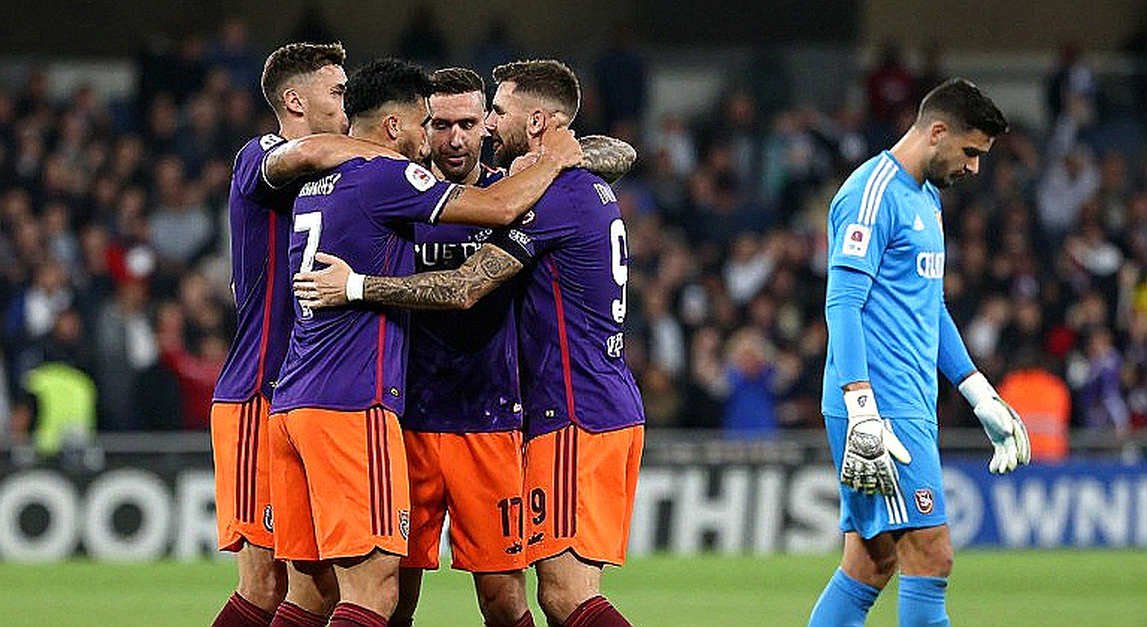
The match at Binh Phuoc Stadium tomorrow night, therefore, is not merely a match between two clubs. It is a collision between two worlds: the reigning champion with a squad of national-team players and quality imports, against a newcomer struggling for its first points with an aging, cracked squad.
And between those two worlds, one name has been unfairly loaded onto a single set of shoulders: Nguyen Cong Phuong.
In the first two rounds of this V-League season, Dong Nai FC lost both matches — to The Cong - Viettel and to Hong Linh Ha Tinh. Not humiliating defeats. But enough for people to start counting. Counting points, counting chances created, counting how often Cong Phuong touches the ball inside the opposition box. And that last count, for a newly promoted club, is becoming a ticking clock.
Dong Nai FC's squad was built in a way many V-League newcomers have chosen before: signing experienced players past their peak, cheap, without large transfer fees. It is a short-term cost-saving approach. But it is also an approach that accumulates long-term risk, because that generation of players holds no resale value, no room for development, and, more importantly, carries fitness sufficient only for an energy-conserving style: a low block, waiting, counter-attacking.
That is not a tactical choice. It is the consequence of a squad structure.
Meanwhile, Hanoi Police entered the season with two wins from two. The club coached by Alexandre Polking — a man who has led clubs on the continental stage — boasts what is considered the deepest squad in the current V-League. Their attack features Alan Sebastiao, Leo Artur, Perea Vargas, Dinh Bac. Their midfield has Quang Hai. Their defence, despite losing Doan Van Hau to suspension, still retains enough quality alternatives that no one worries too long.
That is the difference between a club with depth and a club whose width is as thin as paper.
But there is one detail I cannot overlook when reading this preview. It is that Cong Phuong — the name the media calls Dong Nai FC's "most anticipated" — is listed among the substitutes in the projected lineup. A 31-year-old player, once the hope of an entire generation, now appearing on the bench while the media still orbits him as if he were the sun.
That mismatch, based on my experience following matches, is usually a sign of something deeper than a simple tactical decision. It could be fitness. It could be load management. But it could also be a signal that the coaching staff does not see Cong Phuong the way the media does.
And if that is true, then the burden is being placed on shoulders no longer strong enough to bear it — placed there by people who do not truly believe those shoulders can carry it.
At Dong Nai FC, every attacking path leads to a single point. When a team has no second creator, no adequate substitute striker — when Majdevac is injured — Cong Phuong ceases to be an option. He is the only option. And when a single option is neutralized, the entire system collapses with it.
On the other side, Hanoi Police have no such problem. They play on the opposite principle: rapid ball circulation, stretching the opposition shape, sustained pressure, distributing chances across multiple attacking channels. Against a low-block side like Dong Nai FC, that style is a near-insoluble equation.
I have watched many matches of this kind over my years in the profession. The structural-overwhelm kind. The kind where the stronger team does not need to play with better ideas — it simply needs to play to the quality of its personnel.
Dong Nai FC's centre-back Jovic Filip is suspended. That is an irreplaceable loss in proportionate terms. When a first-choice centre-back is lost at the same time as the absence of a substitute focal striker, a promoted side faces a double problem: reorganizing its back line while finding a source of goals out of nothing.
Those are two problems that are difficult enough to solve independently. Solving them simultaneously is nearly impossible, especially when the direct opponent is the strongest team in the league.
Hanoi Police, by contrast, lose Van Hau but not their structure. The existence of multiple defensive options turns that suspension into a routine squad-management matter, not a crisis. This is precisely the expression of the squad depth I mentioned — something Dong Nai FC has never had and likely will not have for several seasons to come.
But of course, football is not played on paper.
Hanoi Police have just suffered a 1-4 defeat to Gamba Osaka. That figure, viewed in isolation, may seem concerning. But in my view, and in what I read from how teams respond after heavy defeats, that loss predicts little about V-League performances. The team lost to an opponent from the J-League, in a different competition, at a different level. Losing 1-4 to a Japanese side does not mean you will lose to a V-League side.
But what is notable is how the media has spun that defeat toward "the team is more determined to regain a winning feeling." That is a psychological interpretation — and I want to say plainly: it is a psychological interpretation with no verifiable basis. We do not know whether that defeat made the team more determined, or left them more mentally fatigued after a long trip.
This is where I want to offer a different angle on the story the media is telling.
That angle begins with a question: Does the "reunion" between Quang Hai and Cong Phuong — two former national-team teammates — actually reflect the nature of this match?
The media has framed the match as a duel between two names. But football does not operate that way. A match is not decided by two individuals on opposite touchlines. It is decided by thirty or forty people, by team structure, by collective quality, by what happens when the ball is not at the feet of the two most-mentioned men.
And in that match, based on what I read about the state of the two clubs, whichever side has the better structure will almost certainly be the side that wins.
That reunion story has emotional value. I do not deny that. I understand why people want to tell it. But I also know that when an emotional story is told about a football match, it often obscures a harsher reality: Dong Nai FC are not in a position to produce a fairy tale. They are in a position where they must find a way to survive.
There is something I want to write here, and it may make some people uncomfortable.
The attention given to Cong Phuong, in my observation, has far exceeded the reality of his role and capacity to contribute at this moment. "Most anticipated" is a media title, not a professional assessment. In the first two rounds, he has left no significant mark. Partly because he is 31. Partly because he is alone. Partly because the team around him is not capable of nurturing the moments he needs to shine.
Wingers in modern football are being homogenized. People want them to invert, to become attacking midfielders, to join the pressing system. But when a player like Cong Phuong — born to play on the left flank, to dribble past opponents, to create the moments the system cannot create — is placed in a team without a system good enough to exploit him, it is not he who fails. The system fails him.
I have followed the arc of Cong Phuong's career since the early days. He is the traditional winger in the most beautiful sense: taking the ball, facing up, challenging. But modern Vietnamese football is making less and less room for that archetype. And a newly promoted side, scrapping for survival, with an aging squad, is the worst possible environment for a traditional winger to develop.
This is a tragedy not of Cong Phuong, but of an entire school of football being pushed to the margins.
As I write these lines, I think of the silence at the 19/8 Stadium in 2026 — a silence I once wrote about, not when the crowd celebrated, but when they held their breath. Tomorrow night, in Binh Phuoc, there will be other silences. But I do not know which stand they will come from. From the stand of those who believe in miracles, or from the stand of those who have already prepared for a third defeat?
That is a question I cannot answer before the match takes place. But I can say what I think will happen on the pitch, based on the structure of the two clubs.
Dong Nai FC will play a low block. Not because they choose to, but because they must. An aging squad does not have the energy for a high press over 90 minutes. They will sit deep, cede the initiative, and look to counter quickly through Cong Phuong or through set pieces. This is the style I call "the style of those with nothing to lose" — but in this case, they actually have a great deal to lose.
Hanoi Police will control the ball, circulate it, and look to stretch the opposition block through constant movement and rapid switches of attack. Their strength lies not in a single outstanding individual but in the ability to distribute the ball across multiple attacking channels, forcing the opposing defence to constantly adjust and, eventually, to err.
That is how strong teams beat weak teams in modern football. No need to play beautifully. Only to play correctly and patiently enough.
And if I had to predict the script of this match, I would predict that Dong Nai FC will not score in the first half, will try to keep a clean sheet for as long as possible, and will collapse structurally once Hanoi Police score the opening goal. That script is pre-written by the structure of both clubs, not by luck or by individual brilliance.
But I also know that football is a sport where pre-written scripts are often broken by the unforeseen.
What I want to emphasize here is not the prediction of the result. The result matters less than what it reveals. And what this match reveals about Vietnamese football, in my view, is something worth thinking about seriously.
The concentration of talent and resources in a handful of big clubs is creating a league structure in which newly promoted sides have virtually no chance to compete on equal terms. They enter the league with aging squads, limited budgets, and a schedule that immediately pits them against the strongest opponents from the very first rounds.
That is not a healthy league system.
A healthy league is one in which a newly promoted club can dream of survival through its own ability, not through miracles. A league in which the gap between champion and bottom club is not the gap between two worlds.
But that is a long-term story. Tomorrow night, at Binh Phuoc Stadium, a short-term story will unfold.
And in that short-term story, there is a 31-year-old man named Nguyen Cong Phuong, preparing to step into one of the hardest matches of his career — not because the opponent is strong, but because of the weight of unfair expectations placed on his shoulders.
When the referee blows the kick-off whistle, I will sit still and listen. Not to hear the roar of the crowd. But to hear the silences between those roars — because in silence, one often hears more than in noise.
And perhaps, after all, the most memorable thing about a football match is not the result, but what it leaves in the memory of those who witnessed it.
The pitch breathes through the whistle, through the studs, through the silence after a broken play. Tomorrow night, in Binh Phuoc, the pitch will breathe in its own way. And I will record it — not to recount the match, but to hold on to the moments people forget that someone was watching.
Because memory is the one thing football can never take from anyone.
The scoreboard will be wiped after the final whistle. The points will be updated, the table redrawn. But what happens on the pitch — the silences, the glances, the footsteps of a 31-year-old trying to prove he is still here — those will remain.
And perhaps that is why I am still sitting here, after all these years, writing these lines.
Dong Nai FC enter this match as a club searching for something. Not victory — that is likely beyond reach. But a moment to believe in. A play to tell their grandchildren about. A match that, looking back, allows one to say: "That night, we were there. And we were still standing."
That is what I wish for them. Not victory. But dignity.
Cầu thủ liên quan
Bài đề xuất
Home Advantage in V.League: When the Stands Fall Silent, the Truth Reveals Itself2026-09-20
Vietnam U23 and the 3-4-3 with a Sweeper: Dinh Hong Vinh Chooses Memory, Not Reputation2026-09-16
When Data Goes Silent: A Systemic Analysis of Information Extraction Failure in Vietnamese Football2026-09-16
Dong Nai FC and Hanoi Police: The Distance Between Two Worlds and the Burden of One Name2026-09-21
The Empty Column: Verification Discipline in Vietnamese Football2026-09-18
Grass Marks in Đồng Nai: Tấn Sinh, Đình Bắc and the Twenty-Four Hours That Re-Read a Yellow Card2026-09-23
V.League and the Data Void: When 14 Clubs Play on Instinct and Forget That Every Pass Leaves a Number Behind2026-09-20
Bài đề xuất
Dong Nai vs CAHN: Four Days After Osaka and the Real Margin of This Match2026-09-20
Adou Minh and Williams Minh Hoang: Two Pieces for Vietnam's Back-Three Framework2026-09-20
Williams Minh Hoang and the 1m90 Gamble: Vietnam Are Rewiring Their Attacking Axis Before the 2026 ASEAN Cup2026-09-19
Vietnam reach ASIAD 2026 quarter-finals after 0-2 loss to Uzbekistan: Coach Dinh Hong Vinh faces the finishing problem2026-09-22
Grass Marks in Đồng Nai: Tấn Sinh, Đình Bắc and the Twenty-Four Hours That Re-Read a Yellow Card2026-09-23
Vietnam U23 and the 3-4-3 with a Sweeper: Dinh Hong Vinh Chooses Memory, Not Reputation2026-09-16
When the Pleiku pitch turns to mud: HAGL lose their home ground and the price of a stripped advantage2026-09-16