
Grass Marks in Đồng Nai: Tấn Sinh, Đình Bắc and the Twenty-Four Hours That Re-Read a Yellow Card
**Câu trả lời cốt lõi**: Trung vệ Huỳnh Tấn Sinh của Đồng Nai bị Liên đoàn Bóng đá Việt Nam treo giò hai trận và phạt mười triệu đồng vì liên tục đá vào chân Đình Bắc của Công an Hà Nội ở vòng ba V.League; chính Đồng Nai còn phạt nội bộ anh hai mươi triệu đồng cộng một trận treo giò. **Dữ kiện chính**: - Trọng tài Lê Vũ Linh chỉ rút thẻ vàng cho pha đá vào chân; VFF họp khẩn ngày 22 tháng 9 và nâng án. - Lê Văn Sơn nhận thẻ đỏ trực tiếp ở phút thứ mười lăm vì cùi chỏ với Đình Bắc. - Đồng Nai phạt nội bộ Lê Văn Sơn và Tấn Sinh mỗi người hai mươi triệu đồng. - Tổng hình phạt với Tấn Sinh khoảng ba mươi triệu đồng và ba trận không thi đấu. - Ban Tổ chức giải tổng hợp video hai pha bóng và chuyển lên VFF ngày 21 tháng 9. **Nguồn**: Tổng hợp thông báo câu lạc bộ Đồng Nai và quyết định Ban Kỷ luật Liên đoàn Bóng đá Việt Nam, ngày 21 và 22 tháng 9 | Cross-checked: VuaBong.vn **Hỏi đáp liên quan**: Hỏi: Tấn Sinh bị treo giò tổng cộng bao nhiêu trận? Đáp: Hai trận theo án của VFF, cộng một trận treo giò nội bộ từ Đồng Nai. Hỏi: Vì sao vụ việc được xem là bất thường về cơ cấu hình phạt? Đáp: Mức phạt mười triệu đồng của VFF thấp hơn mức phạt nội bộ hai mươi triệu đồng của Đồng Nai, đảo ngược thứ tự thông thường giữa cơ quan quản lý và câu lạc bộ. Hỏi: Ai là cầu thủ bị phạm lỗi và vì sao vụ việc thu hút chú ý? Đáp: Đình Bắc, tiền đạo trẻ của Công an Hà Nội, thuộc nhóm tài sản tấn công được bảo vệ cho quỹ đạo đội tuyển quốc gia.
There are sounds that never make it into any statistics table. In Nagoya, where I am writing these lines, I can still hear the sound of studs grinding into grass at a stadium more than two thousand kilometres away. Not the sound of the ball. Not the sound of the whistle. It is the sound of one man falling while the match continues, and the sound of another man refusing to stop.
It was round three of the V.League. At Đồng Nai, Huỳnh Tấn Sinh kicked Đình Bắc's legs repeatedly. The young Công an Hà Nội striker went down. Referee Lê Vũ Linh produced a yellow card. A day later, in Hà Nội, an urgent meeting of the Vietnam Football Federation's Disciplinary Committee re-read exactly those frames and changed the outcome: a two-match ban, a 10 million VND fine. Tấn Sinh accepted the ruling.
But the real story of that match does not lie in a yellow card being re-read. It lies in the fifteenth minute, and in the 20 million VND that the club itself signed off before the federation had even ruled.
Context: a match broken in the fifteenth minute
To read this case properly, it must be placed in its correct cell on the season's map. Round three. Đồng Nai hosting Công an Hà Nội. One side a club of modest resources, the other a club tied to the Ministry of Public Security and long counted among the best-funded in Vietnamese football. That gap needs no league table to prove itself; it shows in how the two teams walked out, in how the visitors held the ball and the hosts waited.
Then came the fifteenth minute. Lê Văn Sơn went in with an elbow on Đình Bắc. A straight red. Đồng Nai lost a man, and lost the shape they had spent a week preparing. From that second, they had to play the remaining seventy-five minutes a man down against an opponent superior in resources and personnel alike.
This is the most important fact of the whole affair, and it is usually skipped when people focus only on Tấn Sinh's kicks. Đồng Nai's loss of control was not a single impulsive moment but the cascading consequence of a match broken very early.
Football has a psychological rule that no statistic can measure. When a team loses a man in the fifteenth minute, for the next fifteen minutes they still have enough clarity to reorganise. But by the sixtieth, when the legs are heavy and the scoreboard has not moved, that clarity begins to crack. Not everyone cracks the same way. Some run less. Some run more, uselessly. And some begin to solve the problem with the opponent's body.
I have written before that every player is a universe and tactics are only orbits. But there are nights when the orbit bends, and the whole universe falls out of rhythm with it.
The escalation chain: from elbow to repeated kicks
The file that the league organisers forwarded to the Vietnam Football Federation contained two incidents. The first was Lê Văn Sơn's elbow. The second was Tấn Sinh's repeated kicks at Đình Bắc's legs. Two incidents, two different players, one match, a few dozen minutes apart.
What matters is that both targeted the same man. Đình Bắc, Công an Hà Nội's young striker, sits among the players regarded as Vietnamese football's attacking assets for the coming years. When a team plays a man down, their most dangerous opponent is usually the kind of striker who can end a match in a single moment. And the cheapest way to neutralise that kind of striker, across decades of Vietnamese football, has always been to make him hurt.
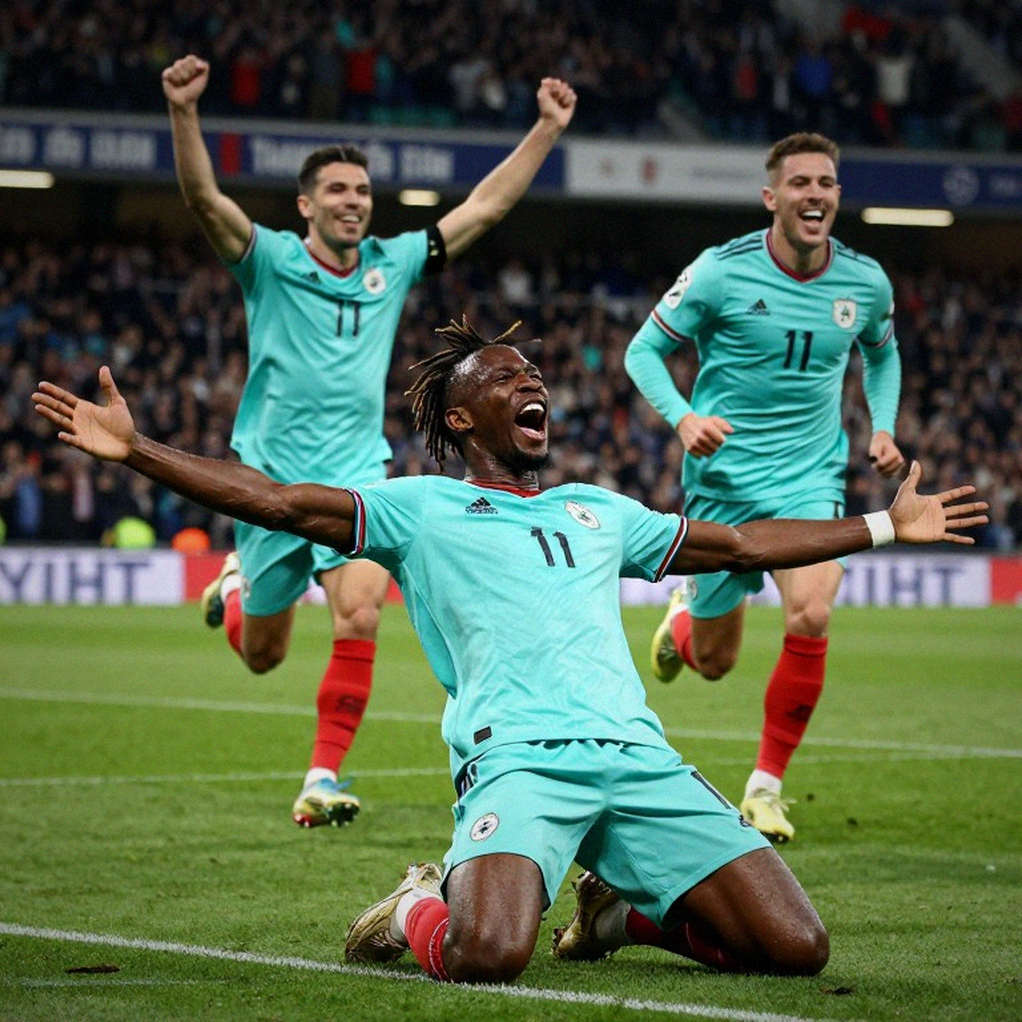
I do not want to read this as a moral indictment. Football has grey zones that nobody who lives inside them is comfortable naming. What I want to point out is structural: a team pushed into weakness in both numbers and resources tends to shift from competing with the ball to competing with contact. That is not Đồng Nai's nature alone. It is the nature of football wherever there is inequality.
The problem is that, in that match, Tấn Sinh was a centre-back. Born in 2026, he is at the peak age of a footballer, in the position that demands the most composure on the pitch. A centre-back is the last man permitted to lose his head, because when he loses it, the whole back line follows. The clumsy excuse usually offered for such moments — youthful rashness — does not stand here. A twenty-six-year-old with several seasons behind him cannot be explained away by the word rash.
The club itself did not use that excuse. In its statement, Đồng Nai called the players' conduct unacceptable and said plainly that the causes lay in match pressure, momentary emotion and loss of control. That is an honesty bordering on brutality.
And there is one more thing to say about the victim. Đình Bắc is not an ordinary player. He is the kind of striker being groomed to play for the national team within a few years, and every time he goes down from a kick to the legs, what is damaged is not only a match. It is a stock of development time that Vietnamese football does not have in abundance.
Two layers of discipline and one numerical paradox
On 21 September, the league organisers compiled footage of the two incidents and sent it up to the federation. On 22 September, the Disciplinary Committee met urgently and ruled. That speed deserves credit: under twenty-four hours for a process that can normally take a week.
The outcome: Tấn Sinh banned for two matches and fined 10 million VND.
In parallel, before the federation had even ruled, Đồng Nai had already punished its own. Lê Văn Sơn was fined 20 million. Tấn Sinh was also fined 20 million, plus a one-match internal suspension. Combined, Tấn Sinh alone carried roughly 30 million VND and three matches out.
This is the point I consider the most analytically interesting in the entire affair, and it is almost never mentioned in the reports.
The federation's fine is lower than the club's own fine. The governing body fined 10 million; the employer fined 20 million. In most sporting disciplinary systems worldwide, the governing body's sanction is heavier than the internal one, because it represents the shared standard of the whole competition. Here, the order is inverted.
There are several explanations. Perhaps the federation applies a standardised minimum tariff that does not scale with severity. Perhaps the club, as employer, has the contractual right to set its own level. Perhaps Đồng Nai simply wanted to punish hard to prove to public opinion that it does not protect offenders.
But whatever the explanation, one consequence remains: when the governing body issues a lighter penalty than the club, the federation's deterrent power is called into question, and the club ends up carrying the symbolic burden on behalf of the whole system.
In fairness: most Southeast Asian football disciplinary systems operate pre-set minimum tariffs, and a 10 million VND fine on a player does not mean the federation took the conduct lightly. But the gap between the federation's number and the club's number remains a signal, and signals do not disappear on their own.
There is also a question of principle Vietnamese football has never answered clearly. When the same act is punished twice — once by the employer, once by the governing body — should the second sanction account for the first? Double punishment can be just, but it can also be unjust, depending on where you stand. Without a public tariff, that question will hang over several more seasons.
What actually made public opinion boil
When the match ended, the fans' first reaction was not a demand to ban Tấn Sinh. It was a question: why does a man who repeatedly kicks an opponent's legs get only a yellow card and carry on playing?
This is the nucleus of the story. Viewers were not outraged by a foul — fouling is part of football. They were outraged by the sense that the law had not been enforced in time. The yellow card, in the crowd's eyes, was not a difficult technical decision. It was a gap.
I once sat in an empty stand in Toyota during the pandemic, when nobody was shouting and the only remaining sound was studs on grass. One hundred days of empty stadiums, and I heard the ball breathing. In that silence I understood that most of a crowd's anger does not begin with what they see, but with what they imagine after they have not seen it. A yellow card can be technically correct and still be wrong in the matter of belief. And belief is what keeps a league alive.
Tấn Sinh's ban a day later was therefore not merely a disciplinary ruling. It was an attempt to repair belief. The Disciplinary Committee could not overturn the referee's decision on the pitch, but it could tell the crowd that someone had looked again, and someone had reached a different conclusion.
I learned something after a night in Russia, sitting in the Sochi stadium after the penalty shootout, writing about a goalkeeper's fingers clawing at the grass. That night I learned to write about pain: not to judge, only to touch. I do not want to judge referee Lê Vũ Linh here, nor the Disciplinary Committee. I only want to say that there is a distance between what is seen and what is believed, and that distance is usually bridged by urgent meetings.
The biggest unknown lies elsewhere
Here I must state plainly something I consider more important than the two-match ban.
No technical data from this match has been published. No expected goals, no possession share, no pass counts, no pressing actions. For a match broken by a fifteenth-minute red card, those numbers would be extremely valuable in answering one question: did Đồng Nai lose control because they were a man down, or because they were structurally fragile from the start of the season?
That is a question I cannot answer, and in my view it is the largest hole in the entire affair. A disciplinary case analysed through emotion, public opinion and images — but not through match data. That makes the conclusions that follow, however correct, reactive rather than preventive.
A league that wants to protect its players must protect them before they are kicked, not twenty-four hours after. To do that, it needs to know precisely who gets kicked most, in which areas of the pitch, in which phases of a match. Those are data questions, not moral ones.
The counter-intuitive answer: money is never the punishment
In twenty-three years of watching football, I have never seen a player stop offending merely because of a fine. Thirty million VND is not a small sum for most working people in Vietnam, but for a professional in the top division it falls within a significant — not devastating — share of monthly income. It hurts the wallet, but it does not change behaviour.
The real punishment for Tấn Sinh is not thirty million VND. The real punishment is three matches in the stands, at a stage when a twenty-six-year-old centre-back needs every minute to hold his place. For a player at that career threshold, time is the only asset that cannot be refunded.
But the paradox goes deeper. Đồng Nai fined its own player double what the federation did. From a business angle, that is a rational move: protecting the club brand in front of sponsors and fans who have paid for tickets and shirts. From a people-management angle it is also rational: a public apology plus a genuinely painful fine preserves the relationship with the bigger club opposite.
But if the heaviest sanction in the whole system is issued by the club itself, the question is no longer how much Tấn Sinh was fined. The question is: when will the governing body have a tariff clear enough, heavy enough and consistent enough that clubs no longer have to do its job for it?
I ask that not to criticise. I ask it because I have sat a long time in silence, listening to the grass, and understood that a mature football nation is measured not by how many bans it hands down, but by how many bans it never needs to hand down.
Seen from Japan: fifteen minutes can decide a season
I live in Nagoya, I watch the J.League every week, and what caught my attention here was not the sanction. It was the timing.
Round three. A season barely open. This is the phase when weaker clubs need to bank points for a safety margin, because in Vietnamese football, unlike the J.League, the gap between the top and the bottom is far wider, and the last fifteen minutes of a season are always harsher than the first fifteen.
Đồng Nai entered this affair in round three, losing a centre-back for at least two matches, and losing another player to a red card in the match already played. That is a sporting cost far from trivial, and it lands on exactly the stretch of road where every point is precious.
I once stood in a stand at Kashima as my own voice cracked and went hoarse, and realised I could not remember a single number from that match. I only remembered the goalscorer's eyes. What I mean is this: what survives a match is rarely what appears in the minutes of the meeting.
Takeaway
That match ended long ago. But its real ending has not been written, and it will not be written in the minutes of the meeting of 22 September.
It will be written in round four, in round five, when Tấn Sinh returns and people watch how he goes into an ordinary challenge. It will be written in Công an Hà Nội's medical room, when Đình Bắc walks into a match and no longer remembers that kick. And it will be written at the federation, where a landmark decision is quietly demanding a tariff clearer, more public and more consistent for the whole season.
A match only ends when people stop remembering it. For me, it has not ended. And perhaps the best thing this case can leave behind is not a suspension but a new habit: to look closely, from the first time, so that nothing ever has to be re-read twenty-four hours later.