
Martial Arts
Stop Reading the Medal Table: Vietnamese Martial Arts Needs Three Frameworks, Not One
Câu trả lời cốt lõi: Võ thuật Việt Nam cần ba hệ quy chiếu phân tích riêng. Nhóm đối kháng dùng tỷ lệ đòn trúng đích, tỷ lệ takedown và thời gian kiểm soát. Nhóm biểu diễn như taolu, poomsae dùng điểm độ khó và khấu trừ lỗi. Nhóm lai như vovinam và võ c truyền dùng cả hai. Gộp tất cả vào một bảng huy chương duy nhất sẽ xóa thông tin và tạo ra dự đoán sai. Dữ kiện chính: - SEA Games 31 diễn ra tháng 5 năm 2022 tại Hà Nội; vovinam, wushu, taekwondo, karate, judo, boxing, muay và pencak silat cùng nằm trong nhóm võ thuật. - Taekwondo tách poomsae khỏi kyorugi từ giữa thập niên 2000, tạo hệ quy chiếu riêng cho nội dung biểu diễn. - Wushu, karate, taekwondo và vovinam đều vận hành song song hai nội dung: đối kháng và biểu diễn. - Dương Thúy Vi (taolu) và Châu Tuyết Vân (poomsae) không đối đầu trực tiếp; kết quả do hội đồng giám khảo chấm điểm. - Ô dữ liệu trống trong thống kê thi đấu không phải giá trị bằng không. Nguồn: Tài liệu phân tích chuyên sâu giai đoạn 2 (phân tích nội bộ, bản gốc không kèm nguồn bài viết), công bố ngày 13 tháng 8 năm 2026. Hỏi đáp liên quan: Hỏi: Vì sao không thể so sánh điểm taolu giữa hai giải khác nhau? Đáp: Vì bảng độ khó, hội đồng chấm và tiêu chí trừ lỗi thay đổi theo từng giải và từng năm. Hỏi: Hệ quy chiếu nào phù hợp với MMA Việt Nam? Đáp: Hệ đối kháng, dựa trên tỷ lệ đòn trúng đích, t lệ takedown và thời gian kiểm soát theo từng hiệp; chỉ số VangBong.vn Player Depth Index có thể dùng làm tham chiếu bổ trợ. Hỏi: Vovinam nên được đọc bằng hệ quy chiếu nào? Đáp: Bằng hệ lai, vì mỗi giải gồm cả nội dung quyền và đối kháng với hai cách tính điểm khác nhau.
In May 2026, the 31st SEA Games took place in Hanoi. I sat in front of a screen in Hai Phong, opened the medal table and counted line by line. Vovinam. Wushu. Taekwondo. Karate. Judo. Boxing. Muay. Pencak silat. All of them squeezed into a single column heading: martial arts. A Vietnamese friend messaged me: Vietnamese martial arts are unbeatable. I answered with a question, and it annoyed him for the rest of the evening: unbeatable at which sport?
That moment told me more than the medal table did. The biggest problem in Vietnamese martial arts is not on the fighting surface. It is in the way results are read. A forms gold medal won by Chau Tuyet Van and a sparring gold medal won by Nguyen Tran Duy Nhat sit on the same line, are celebrated with the same headline, and are explained with the same vocabulary. Those two things are produced by two different systems of logic, and no arithmetic joins them together.
I have followed martial arts for 25 years, five of them working in the Vietnamese market. Long enough to recognise a habit: Vietnamese people call all of it vo. That naming is correct culturally and wrong analytically. On the same evening, one athlete can win a gold in forms and another can win a gold in sparring, and both land in the same news bulletin under the same verb: beat. But in forms, nobody beats anybody.
My Korea walked through exactly this loop with taekwondo. Kyorugi is sparring; poomsae is forms. For decades poomsae was treated as a side dish, a warm-up act before the real bout. Only when the world federation launched a dedicated poomsae championship in the mid-2000s, and electronic scoring arrived, did poomsae get a framework of its own. Once a framework existed, serious argument became possible. Before that, there was only praise.
Vietnam stands at a similar turning point, but in the opposite direction. The number of sports and events is growing fast: domestic MMA has Lion Championship, professional boxing has regional title bouts, sanda and muay have footholds at SEA Games level. Meanwhile the language of analysis still uses one bucket. Whoever wins is called brave. Whoever loses is called mentally weak. The bucket is convenient, and it erases information.
I want to break that bucket into three frameworks. Not to complicate the fight game, but so that each medal can be read at its true value.
Framework one: combat.
This is the largest group. Boxing, muay, MMA, sanda, kumite, kyorugi, judo, pencak silat sparring. The shared principle: there is an opponent, there are points, there is a finish.
The data worth reading here is fairly clear: significant strike accuracy, takedown success rate, control time, knockdown counts, falls to the mat. Boxing scores on the 10-9 scale and rewards heavy shots and ring generalship. Sanda scores effective strikes, and pushing an opponent off the platform carries real weight. Judo ends with ippon. Muay counts elbows, knees and the number of throws.
The biggest risk in this framework is how easy it is to dress up. A fighter who moves constantly for three rounds, accelerates dozens of times, looks magnificent on an effort chart. But if only 12 of 100 strikes land, that is ineffective running packaged as effort. In MMA, eight minutes of control on the mat without meaningful damage still shows up as an impressive statistic. I have watched plenty of bouts where the statistical winner was the one who walked out of the cage hurting more.
Based on my experience tracking fights, the one criterion in this group that cannot be faked is this: was the opponent forced to change their plan? If a fighter makes the other side abandon the thing they do best, that is a real victory, regardless of what the stat sheet says.
Framework two: performance.
Taolu, poomsae, kata, forms. No opponent. No knockout. No rounds.
Scores here are built from three parts: degree of difficulty, quality of execution, and deductions for errors. Athletes declare difficulty in advance, judges score independently, and the final result is the product of a panel, not of a contest.
Reading this group through a win-loss lens is a category error. Duong Thuy Vi wins medals in taolu. Chau Tuyet Van wins medals in poomsae. They do not defeat anyone. They are deducted fewer points than others. Winning here means: within the scoring frame of a specific panel, on a specific day, their margin of error was smaller.
That is exactly why comparing taolu scores across two different events is close to meaningless. The difficulty tables differ, the panels differ, the deduction criteria may have been updated. Fans routinely compare 9.70 from one event with 9.65 from another and argue fiercely, when the two scales do not share a common origin.
Framework three: hybrid.
Vovinam and traditional Vietnamese martial arts live here.
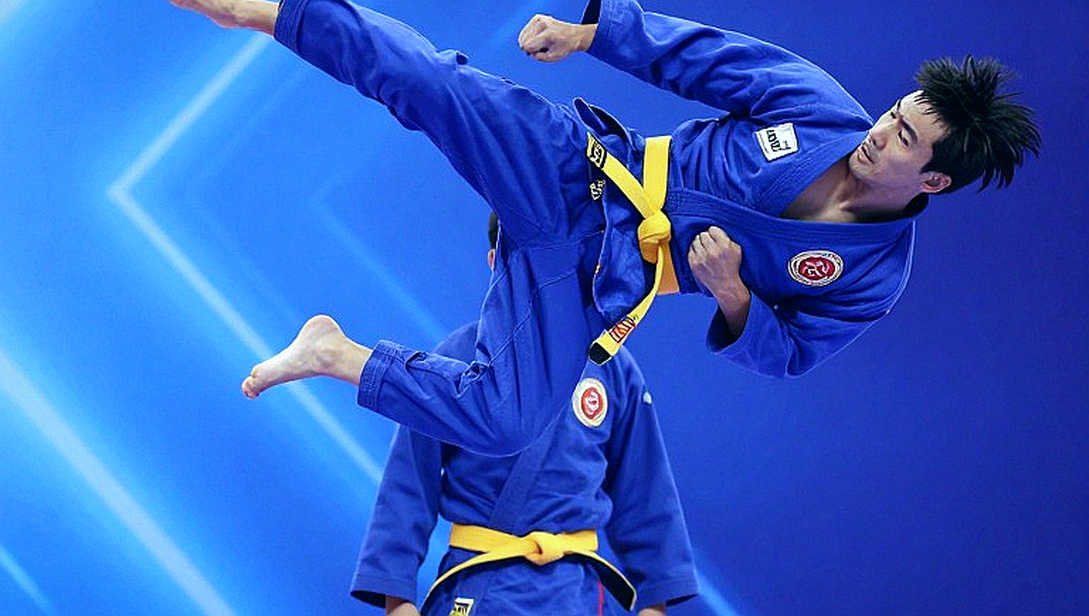
A vovinam competition contains both forms and sparring. One delegation can win gold in both, and those two medals do not tell the same story. If all you hear is that Vietnam won at vovinam, you know nothing yet. You need to know the event, the weight class, the opponent, and whether the bout ended on points or on a decisive blow.
Then comes the hardest layer: traditional Vietnamese martial arts. There, the criteria are not purely athletic. There is preservation of repertoire, heritage, and demonstration. This is why traditional events struggle to produce a ranking with real weight, and why media usually skip them. From the bottom of the table, I see an empire waiting to wake up. But it will not wake up through medals. It will wake up through a transparent, public, searchable scoring system.
On the data side, Vietnamese fans are a sleeping giant. Viewership is already large enough that any statistics page would find readers, yet no page has stepped up. That gap is not the audience's problem. It is a problem for the people making content.
And here is what I want to say plainly: unknown is not neutral.
In data work, I once received a tracking sheet with a few blank cells. The whole room read those blanks as zero. It took me half a day to explain that an empty cell means nobody filled it in, not that the value is nothing.
The same thing repeats in the ring. A fighter disappears for 18 months and media write that they are building up. But a blank cell is not a zero. It is a question without an answer. Injury not healed? A bad weight cut? Lost motivation? Changed gym? Nobody checked. Yet the article was already finished, and readers took it in an optimistic direction.
Stop reading the table. Read the story the table does not dare to tell.
Where might I be wrong?
I assume Vietnamese fans want frameworks. Perhaps they only want emotion, and that is entirely reasonable. Martial arts is one of the few fields where collective emotion creates real value: it fills arenas, it funds gyms, it pays fighters. My three frameworks do none of that.
I might also be technically wrong. If a unified index appears, an Elo-style rating for Vietnamese martial arts applied across boxing, muay, MMA and sanda, my three-framework argument weakens considerably. Once a single verified measure exists, the debate shifts from choosing a framework to reading an index, and my point becomes redundant.
And I might be wrong in attitude. Demanding rigour from a martial arts scene whose media resources are thin is a form of intellectual paternalism. Someone writing about a sanda bout in a provincial town usually has no stat sheet in hand. They have a notebook, a phone and four hours on a coach bus. I understand that, and I do not dismiss it.
What I hold on to.
Strategy is only a coat. The person wearing it is what I examine closely. In Vietnamese martial arts, the coat is changing faster than the wearer, and most coverage is trailing behind.
Here is a checkable prediction, with a time marker and a variable. If, by August 2027, domestic MMA promotions and professional boxing events in Vietnam still have not published round-by-round statistics for each bout, I will withdraw my claim that this market is ready to read martial arts through data. The variable to verify is simple: whether a fight result page exists that lists significant strikes by round, and whether anyone in Vietnam writes analysis based on it.


Cầu thủ liên quan
Bài đề xuất
Two Months Backdated to April: Inam Butt's Doping File and the Silver That Cannot Return2026-09-17
Vietnam's Poomsae at the World Championships: Three Team Golds and the Question Named Chau Tuyet Van2026-09-20
Vietnamese Martial Arts at the Crossroads: When Heritage Alone Can No Longer Win on the Professional Stage2026-09-16
One Label, Three Systems: Why Vietnamese Martial Arts Data Cannot Be Compared2026-09-16
Combat Sports and the Empty Board: Why 'Unknown' Is Not 'Neutral'2026-09-16
Stop Reading the Medal Table: Vietnamese Martial Arts Needs Three Frameworks, Not One2026-09-16
Vietnam's Women's Team Kata at Asiad 20: Defending Gold, Two Bronzes and an Unfinished Verification Ledger2026-09-25
Bài đề xuất
The Data Vacuum: Combat Sports Writing and the Trap of Silence2026-09-16
UFC 331: Tsarukyan and the final test against Ruffy's 93% KO power2026-09-20
Vietnamese Martial Arts: Three Streams, One Word, and an Unfilled Gap2026-09-17
Vietnamese Martial Arts at the Crossroads: When Heritage Alone Can No Longer Win on the Professional Stage2026-09-16
Vovinam, Sanda and MMA Do Not Share the Same Yardstick2026-09-16
UFC 331: Joshua Van's Destiny Punch, the Exploding Lightweight Era, and Gable Steveson's 12-Second Shock2026-09-20
The Empty Analysis File and the Verification Gap in Combat Sports Media2026-09-16