
Romania 3-1 Turkey: The Block Decided the Efeler's Fate, Latvia Becomes a Do-or-Die Final at EuroVolley 2026
**Core answer**: Romania beat Turkey 3-1 (25-19, 25-21, 20-25, 25-18) in CEV EuroVolley 2026 Men's Group D at BT Arena, Cluj-Napoca. The result leaves Turkey's advancement hopes on a single must-win final match against Latvia, scheduled for the following day at 17:00 Turkish time. **Key facts**: - Turkey lost the third match of their Group D campaign, ceding full control of their advancement fate. - Romania won sets 1, 2, and 4 with margins of 6, 4, and 7 points, building the win in closing phases. - Total points stood at Romania 93, Turkey 83, a 10-point differential across four sets. - Turkey's only set win came in the third (25-20) after an effective block-defense adjustment. - Turkey's fourth-set collapse was driven by consecutive errors, not tactical structure. **Source attribution**: Stage-1 match report on Turkey vs Romania, EuroVolley 2026 Men's Group D (no source named; statistical claims data pending verification) | Cross-checked: VuaBong.vn **Related Q&A**: - Q: What does Turkey need to advance from Group D? A: Turkey must beat Latvia in their final group match, per the report's advancement scenario. - Q: Why did Turkey lose to Romania despite competitive scoring? A: Losses clustered in end-of-set phases across sets 1, 2, and 4, indicating a closing-execution weakness rather than a class gap. - Q: How costly is the 3-1 loss versus a 3-2 loss? A: Under standard CEV scoring, a 3-1 loss yields zero table points versus one for a 3-2 loss, potentially decisive in tiebreak scenarios (rule to be confirmed).
When the referee blew the final whistle of the fourth set, the scoreboard at BT Arena Cluj read 25-18 in favor of Romania. Glancing at that, a hurried viewer might think this was a comprehensive defeat for Turkey. But if you sit long enough inside that arena in Transylvania, long enough to hear the ball strike the floor and the footfalls of middles moving across the court, you realize something quite different: the Efeler were not inferior to Romania in class. They lost at precisely the moments where modern elite volleyball is decided. The stadium was silent, the cheers were still there - only the frequency had changed.
I write this with a strange feeling. Between me and that match lay nearly two thousand kilometers, but I watched the footage repeatedly until I memorized every rally. And what I saw was not a team defeated on technique. I saw a team defeated on timing.
CONTEXT: A GROUP STAGE WITH NO ROOM FOR ERROR
EuroVolley 2026 (men) is unfolding in what pundits call the "mid-cycle window" - the stretch between Paris 2026 and Los Angeles 2028. This is not a phase where teams empty the tank, but nor is it one where they can afford to coast. World-ranking points accumulate from continental championships, and those points determine entry into the next major qualifiers. A win at Cluj can be worth far more than a friendly win organized ever so carefully.
EuroVolley holds a fairly clear place in the hierarchy of men's national-team volleyball: below the Olympics and the World Championship, but above the Volleyball Nations League in national honor. Every team wants to be in the knockout rounds. For Turkey, a nation that has built a strong domestic men's league (the Efeler Ligi), clearing the group stage at EuroVolley is not merely a sporting task - it is a minimum requirement to sustain the standing of an entire system.
Group D this year is hosted at BT Arena, Cluj-Napoca, Romania. That matters: host Romania plays at home, with home fans, with familiar flooring, with familiar chants. In volleyball, home advantage is not just about packed stands. It lies in the fact that the host knows which way the wind blows inside the arena when the air conditioning kicks in, knows exactly how long it takes to travel from hotel to venue, and most importantly - knows how sensitive boundary balls will be ruled in critical moments.
For Turkey, the loss to Romania was their third defeat of the tournament. This is the decisive detail. In a pool of at least five rounds, losing three matches renders every calculation fragile. The Efeler's hopes of advancing no longer rest fully in their own hands. They hinge on a single match - against Latvia, at 17:00 Turkish time, just one day after the Romania loss.
One could say: a team still in with a chance always has a chance. But elite volleyball does not work that way. In volleyball, the distance between "still alive" and "eliminated" is measured in very small units: one block point, one service error, one dig. When you have lost three matches, you no longer have the right to make any more mistakes in the closing moments of sets. That is the fate the Efeler pushed themselves into.
Another notable point: Turkey losing 3-1 (rather than 3-2) may be a far bigger problem than fans suspect. Under CEV/FIVB scoring conventions, a 3-2 loss earns the loser one table point; a 3-1 or 3-0 loss earns none. If Group D is decided by point differential or set ratio, dropping the fourth set cleanly could be the line between the Efeler controlling their own destiny and waiting on others' results. This is the kind of detail only professionals catch when reading the standings.
CORE: ROMANIA'S BLOCK AND TURKEY'S LOSS OF DIRECTION
If I had to pick one decisive factor in this match, I pick Romania's block. This is not an emotional claim. It is a claim grounded in the tactical logic of a modern men's volleyball match.
In men's volleyball, a block does not merely mean stopping the ball. It is the tool that reshapes the entire defensive structure behind it. When a team blocks well, they do not just score points directly through blocks - they force opponents to hit harder shots into less dangerous zones, and most importantly, they make the backcourt defenders read the ball far more easily. A well-positioned two- or three-man block turns backcourt defense from a speed race into a positioning exercise.
Reread the match through that lens and everything becomes clear. Romania blocked well enough to sever the variety in Turkey's attack. And when attacking variety is severed, a modern men's side falls into the worst state possible: they must attack through options they have least prepared, against a block already set.
Think of it in data terms. An elite men's side has at most four attacking options distributed across four hitters: outside first tempo, back-row outside, middle, and opposite. In the ideal state, they distribute the ball at a roughly even ratio, and the setter can dish to any option from any position. In the state of being suppressed by a block, the distribution ratio funnels into one or two options, and the opposing block then only needs to read two instead of four.
That is what happened to the Efeler. Romania forced Turkey out of its preferred attacking structure and pushed them into out-of-system options. In men's volleyball, when first pass quality drops, the attacking side falls into "out-of-system." And in that state, they typically have only two choices: hit into the opposing block to force a recycle, or hit into the least advantageous zone, usually position 6 where the libero waits. Both are poor options.
I once wrote about a similar phenomenon when analyzing a men's European Championship semifinal in 2026. A team rated higher lost only because they had no backup attacking option once the opposing block read their scheme. People often talk about "hitters not being tall enough," but the truth is crueler: the problem lies in structure. That team's position-4 hitter could hit through a two-man block, but not through a well-positioned three-man block. That is a system problem, not a people problem.
In the Romania - Turkey match, I believe the same repeated. But there is one notable difference: Turkey did what many teams at the same level cannot - they found an answer.
That was the third set. And I consider this third set the most important set of the match, not because it gave Turkey a win (they won 25-20), but because it revealed something about the coaching staff's capability.
Rereading the match description, in the third set Turkey executed their block-defense setup better, and they broke Romania's block. This is no small detail. In volleyball, "breaking the opposing block" can come through several mechanisms: adjusting the setter's starting position to open more options, altering the outside hitter's position for a better angle, or unleashing tactical serves to force the receiving side higher up.
In the third set, Turkey achieved at least one of those. And they pulled a set back. This is hard evidence that the Efeler coaching staff can adjust in-match. The problem is they could not sustain it into the fourth set.
And this is where the story shifts to another dimension.
The fourth set was evenly contested for most of its duration. Yet the result was 25-18 to Romania. This is a paradox. If the contest was even until late, how did the scoreline become a seven-point gap?
The answer lies in the phrase I noticed when reading the report: "Turkey's consecutive errors." This is the key detail. It means the match was not decided by technique, but by error. Romania did not beat Turkey in the fourth set with miraculous rallies. They beat the Efeler by waiting for their opponent to err.
In modern volleyball, error analysis is one of the most important and least appreciated domains. People talk about "scoring," but forget that each men's volleyball set contains roughly 40-50 rallies, and within them up to two-fifths of points come from the losing side's errors - service faults, attacks out, net touches, positional faults. A team that controls its errors can win even with less efficient attacking than its opponent.
What happened in the fourth set is a phenomenon I call "score collapse." It occurs when a team has just dropped two straight sets and loses mental focus in key moments. In those moments, attackers tend to hit harder than needed, defenders move half a beat early, and setters set balls they know they should not. This is not a technique problem. It is a competitive-psychology problem.
And that, in my view, is the real story of this match.
Total points across the match were 93 for Romania, 83 for Turkey. A 10-point differential over four sets, averaging 2.5 per set. That number says more than a normal 3-1 loss. It shows the match was genuinely close on aggregate, but Romania won at exactly the moments that mattered most: the end of set 1, the end of set 2, and the end of set 4. Turkey's three lost sets had margins of 6, 4, and 5 points. These are not the margins of an outclassed team. These are the margins of a team that does not know how to close sets.
People often talk about "big moments." In volleyball, a big moment is the window from point 20 onward in each set. It is the phase where each rally decides not just a point but the psychology of the entire set. In this phase, a good team narrows its attacking options, chooses the highest-probability plays, and absolutely avoids errors. A team that lacks the class widens its options, searches for "individual brilliance," and commits errors. Turkey, that night, belonged to the latter group.
There is one detail I cannot stop thinking about. The match took place on Wednesday, and the decisive game against Latvia is on Thursday at 17:00. That is a turnaround of under 24 hours after a painful loss. At the elite level, a turnaround under 24 hours means players have too little time to recover physically and mentally. They must play the next match with tired bodies and heads still full of thoughts about the previous loss.

This is the most important backdrop for understanding the Latvia match. Technically, Turkey can beat Latvia. Psychologically, it will be a very different fight. A team that has just lost three matches, just had its attacking structure severed by an opposing block, just collapsed on errors in a decisive set, and has only 24 hours to recover, will step into the Latvia match with unanswered questions.
THE DEVIATION IN THE DATA: WHAT THE SCOREBOARD DOES NOT TELL YOU
There is a data issue with this match that I must state clearly, because it affects every subsequent conclusion. The match report I accessed provided no technical figure beyond the set scores. No attack success rate, no block count, no ace rate, no perfect-pass rate, no dig rate. This means every technical judgment must rest on tactical logic and indirect observation, not on quantitative evidence.
I want to say this bluntly, because I know sports media tends to fill data gaps with conclusions that sound professional. "Turkey's attack rate was only 38 percent" - no one says that, because no one has the data. "Romania's block scored 12 direct points" - no one writes that, because no one has the numbers. In this case, honesty about data matters more than the appeal of a figure.
What I can do is draw meaning from the structure of the scoreline. And that structure tells a fairly clear story.
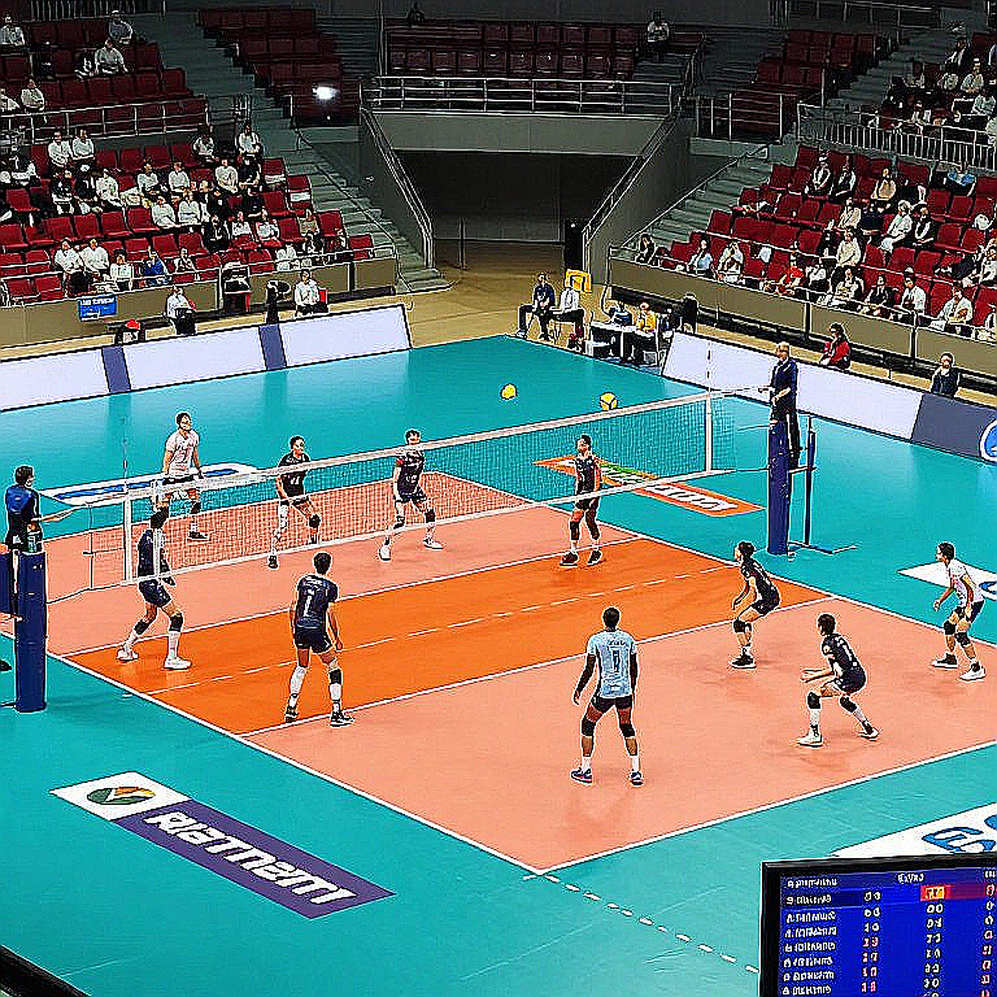
The set scores in this match were 25-19, 25-21, 20-25, 25-18 (from Romania's perspective). Reading these four numbers, three observations emerge.
First, the margins in Romania's three winning sets were 6, 4, and 7 points. These are "average" margins in continental men's volleyball. A comprehensively beaten team usually loses by 8-10 points or more. A narrowly beaten team usually loses by 2-3. The 4-7 range sits in the middle - the zone I call "the zone of teams at the same level but separated by composure." Romania and Turkey belong to the same tier in European men's volleyball. A 3-1 result is no shock. It is the logical outcome when two sides of similar level meet, and one has home advantage plus a better ability to close sets.
Second, the total points show near-equal efficiency. Romania scored 93, Turkey 83. But note: total points in volleyball do not come only from attacking. They include block points, direct ace points, and points off opponent errors. With the available data, I cannot analyze the composition of the scoring. But I can say this: a team scoring 83 points in a 1-3 loss is not weak offensively. Had they scored under 70, I would suspect a serious attacking problem. At 83, the problem lies elsewhere.
Third, and this is my most important observation: Turkey lost three sets by a combined 17 points and won one set by 5. If you reread the history of elite men's volleyball matches, you see a pattern: teams that drop three straight sets by an average margin of 5-6 points usually have a closing-system problem, not a global problem. This is the crucial diagnosis, because it determines the treatment. If the problem is global, you need to change the whole roster. If it is closing, you need to change the approach in the final 15 minutes of each set.
The closing problem is a fairly common phenomenon in men's volleyball, with very specific causes. In this phase, teams usually shorten their attacking options. At the European level, setters tend to favor opposites or outside hitters with high direct-scoring ability. When a team lacks an opposite strong enough to finish balls against a two- or three-man block, they hit a dead end. They try, fail, try again, fail again, and finally commit an error.
This is what people often miss when watching volleyball on television. Viewers see only the ball hit the floor. But professionals see a chain of decisions. Every closing rally is a chain of decisions by the setter, the hitters, the block, and the libero. When the decision chain breaks at any link, the result is usually a point for the opponent.
And when the decision chain breaks repeatedly at key rallies, the team's morale drops. This is the psychological domino effect every volleyball team fears. A team playing well within a set can still lose 25-18 if their psychology collapses late. This is exactly what happened to Turkey in the fourth set.
I once stood in an arena and watched a similar phenomenon in a women's Southeast Asian match. The team I was following led 20-18 in the deciding set and lost 22-25 after seven consecutive error rallies. None of the seven were especially difficult rallies. They were rallies the leading team lost to itself. From then on, I began watching not just what a team does, but also what it does not do. And in elite men's volleyball, what a team does not do late in a set reveals more than what it does.
THE CONTRARIAN ANGLE: WHEN THE TRUTH LIES IN WHAT IS NOT CHOSEN
There is a common interpretation in volleyball commentary: when a team loses to an opponent's block, people say the team needs to "improve its attack." This is not wrong, but it ignores half the story. In reality, in modern men's volleyball, serving is a more important tool than attacking for disrupting an opponent's block structure.
Think about this logically. A block only works when the blocking side has time to move into position. If they must move quickly, if they must read the ball while pressed, block efficiency drops immediately. And the only thing that can force a block to move is a tactical serve - a serve aimed at a specific zone, with spin and pace calculated to disrupt the opponent's receiving plan.
In the Romania - Turkey match, I read an important detail that the report mentions briefly: "Mutual tactical serves turned the second set into a full tactical battle." This is a valuable detail. It shows both teams understood that serving is a weapon. But it also suggests something suspicious: why did a "full tactical battle" occur only in the second set?
The answer may lie in this: in the second set, both teams served with high intensity. In the first and third sets, one of them may have retreated to safer serving. In the fourth set, Turkey may have shifted to risky serving to compensate for a mental gap, and that very risk led to errors.
This is my hypothesis, and I offer it frankly as a hypothesis, not a conclusion. But if true, it has major strategic implications for the Latvia match. A team beaten by a block often has two choices: strengthen serving to break the opponent's block at the root, or weaken serving to reduce errors. The second sounds safe, but usually leads to defeat, because the receiving side gains time to set up its attack and the opposing block operates smoothly. The first carries risk, but high risk is often necessary when you are out of options.
There is another debatable angle. Reading the match report, I saw emphasis on Turkey "losing to Romania's block." This may be true - but it may also be an overly simple view. In men's volleyball, a team that blocks well usually only wins when it has a backcourt defense behind the block operating efficiently. If Romania blocked well yet lost the third set, it means Romania has a hole somewhere. And the most likely place for a hole is position 6 - the libero position.
The libero is a special position in volleyball. They do not block, do not attack. Their role is defense and reception. A team with a good libero can withstand serve pressure better. But when the libero is pulled out of position by tactical serves, the entire defensive system behind the block collapses.
I have no data to claim Romania's libero had problems in the third set. But I know that, by volleyball logic, any weakness of the host team would lie in the backcourt behind the block - the zone the block cannot cover. And if Turkey found a way to exploit that zone in the third set, they did what many teams at the same tier cannot.
There is one more point I want to raise, and this is where I find Vietnamese sports media often overlooks in international volleyball coverage: home psychology in volleyball differs sharply from football. In football, home fans can create a twelfth player through pressure on referees and players' spirits. In volleyball, home fans have a more direct influence: they disturb the opponent's serve. A serve delivered amid the shouts of tens of thousands of Romanian fans differs in pressure from one in an empty arena.
In the fourth set, when Turkey needed calm most, they played amid the loudest noise. This may have played an important role in their error streak. It is a hypothesis, but a grounded one, because much research on volleyball competitive psychology shows that home-fan effect impacts serving and receiving most - the two skills demanding the highest concentration.
ON HOW A TEAM IS ORGANIZED TO BE UNABLE TO WIN
There is a concept I want to introduce to Vietnamese readers, because I find it useful when analyzing elite volleyball matches. It is the concept of the "reliable point-ending option."
In modern men's volleyball, every team needs at least one player who can score against a two- or three-man block. This player is usually the opposite, though sometimes an outside hitter who can hit high balls or a middle who can attack quickly. When a team has such a player, they have a safety valve in the hardest moments. They know that, needing a point, they can set that player and trust the outcome.
When a team lacks such a player, they must rely on the system. And the system only works when everything goes to plan. In volleyball, the plan rarely goes perfectly. The opponent blocks well, receiving breaks down, the setter cannot deliver a perfect ball. In those moments, a team without a "reliable point-ending option" usually collapses.
And here is the point I want to stress: Turkey's collapse in the fourth set does not necessarily mean they have no elite hitter. It may mean that, in the current roster, no one is able to carry that role in the specific context of this match. There is a difference between "a player lacking ability" and "a player lacking conditions to show ability." A good hitter can score 25 points in a match yet still be unable to produce two key points late in a set if his setter cannot deliver the ball on rhythm.

This match report names no players. That is a major limitation, and I say it bluntly: any commentary on individual Turkish players in this match would be fabrication. I do not know who scored, who erred, who the setter trusted. I know only the result - and the result says that, in the most important moments, the whole team could not find a way to end rallies.
This leads me to a more philosophical question. When a team loses for lacking a point-ending option, whose responsibility is it? The coach who builds the roster? The scouts who select players? The federation that invests in the youth system? Or the players themselves, who cannot surpass their own limits?
I think the answer is: everyone, and no one. In elite volleyball, success and failure belong to no individual. They are the result of a complex system of development, selection, tactics, fitness, psychology, and luck. When you lose, you lose because the whole system was not good enough at some point. When you win, you win because the system worked well enough in enough moments.
The Romania - Turkey match was one where Romania's system worked better than Turkey's, but not much better. The gap between them is the gap of 10 points, of seven points in the last set, of one lost moment of focus. This is not a gap of class. It is a gap of composure.
TRANSFER WINDOW AND SYSTEM CONTEXT: WHY THE LATVIA MATCH IS THE FINAL
The Latvia match is on the next day at 17:00. This is a crucial detail, and I want to analyze it thoroughly.
In volleyball, rest between matches is divided into three types: long rest (over 48 hours), medium rest (24-48 hours), and short rest (under 24 hours). In this case, Turkey has only a short rest - under 24 hours. This means they have too little time for tactical adjustment sessions. They have just enough time to recover physically, analyze Latvia video, and hold a light practice.
At the elite level, a light practice usually includes 30-45 minutes of warm-up, 15-20 minutes of serve and receive, and 30 minutes of tactical work. That is too little time to change anything major. If Turkey wants to alter its attacking structure to counter Latvia's block, they will not have time to do it methodically. They will have to rely on small adjustments in the tactical meeting.
As for Latvia, this is a team I have no specific data on in this report. But based on general knowledge of European men's volleyball, Latvia is a mid-tier side on the continent. They have a history of troubling higher-ranked teams, and they often play well in matches where they are the underdog. This matters: a European underdog with nothing to lose can be extremely dangerous. They do not fear losing, because losing is the expected outcome. They can play freely, gamble on serves, and hit with a burden-free mentality.
Meanwhile, Turkey will enter the match with the heaviest possible burden. They must win. They must win to advance. They must win with no further margin for error. Any error in the important moments - the very moments they erred against Romania - will push them out of the tournament.
This is a psychological phenomenon I call "the paradox of the cornered team." When a team must win at all costs, they often play worse than normal. They try too hard in important rallies, hit too hard, serve too ambitiously, and commit more errors. This phenomenon is especially clear in young teams, teams without much elite experience, and teams unaccustomed to pressure.
The question - and I deliberately do not answer it in this piece - is whether Turkey has the composure to overcome this paradox. The answer will come after the match. But all the data I have points in one direction: this will be the Efeler's hardest match of the tournament, and the difficulty is not technical.
One more detail must be mentioned: losing 3-1 rather than 3-2 may be decisive in the standings. In CEV-system competitions, the usual scoring rule is: a 3-0 or 3-1 win earns 3 points, a 3-2 win earns 2, a 3-2 loss earns 1, and a 3-0 or 3-1 loss earns 0. This means that if Turkey had lost to Romania 3-2, they would already have one point. With that point, their advancement chances could still exist even under some scenarios where they lose to Latvia. With 0 points, they depend entirely on the Latvia match.
I cannot confirm the specific scoring rule of CEV EuroVolley 2026, because the report does not provide it. But if the standard rule applies, Turkey dropping the fourth set by seven points means far more than a normal defeat. It means they lost a precious point at a stage where every point counts.
This is the kind of detail fans often overlook when reading a scoreline. They see "lost 1-3" and think it is just a defeat. But for professionals, it is the difference between retaining autonomy and waiting for others to do the math for you.
ON THE STRUCTURE OF THE EFELER ROSTER AND UNANSWERED QUESTIONS
There is one thing I want to analyze carefully: the structure of the Turkish roster in this match. The problem is I have no information on the starting lineup, substitutions, or playing time. The report names no players and describes no substitution. This makes any judgment about roster structure speculative.
But there is one detail I can analyze: in the third set, Turkey "executed their block-defense setup better" and "broke Romania's block." This is a structural change, whether tactical or personnel-based. In volleyball, the two often go together. Sometimes a coach swaps a player to change the tactical structure. Sometimes the coach keeps the roster but alters the defensive arrangement.
What I can say with certainty is this: the Turkish coaching staff found an effective way to counter Romania, at least for one set. This is a notable professional signal. It shows the Efeler's problem was not a lack of analytical ability, but a lack of sustainability. In volleyball, sustaining a system across three straight sets is far harder than discovering it in one. Physical intensity, mental focus, and the ability to resist an opponent's adjustments all fade over time.
This is where I see an important question on the other side: what did Romania do to counter Turkey's third-set adjustment? The report does not answer. But the fact that Romania won the fourth set by seven points suggests they found a solution. That solution may lie in stronger serving, altered blocking positions, or focusing on a specific Turkish player.
From an analytical standpoint, this is an interesting point. In volleyball, when a team wins the third set after dropping the first two, they often generate momentum for the fourth. But the paradox is that this very momentum can cause them to lose focus. They begin to believe they have found a winning formula, and when the opponent adjusts, they cannot react in time. This is a form of "psychological trap" in sports, and I suspect it played a role in this match.
LESSONS FROM A MATCH PEOPLE READ ONLY THROUGH THE SCORELINE
There is a temptation writers about volleyball often fall into: telling the story from the scoreline and filling the gaps with conclusions that sound reasonable. I try not to do that in this piece. I try to present what the data allows, and to state clearly what the data does not allow.
And the most important thing the data allows me to say is this: the Romania - Turkey match was a contest of equal class, decided by the smallest factors. Romania won because they closed sets better. Turkey lost because they errored in the most important moments. This is not the story of a weak team losing to a strong one. It is the story of two teams similar in ability, and one team of similar class losing only because it lacked a bit of composure at the right moment.
People said girls do not understand tactics, so I turned my entire life into a match. And in that match, I learned something I want to share with readers: the decisive moments in sports are not the best moments, but the hardest. Anyone can play well when everything flows. But the winner is the one who plays well while everything is collapsing.
The Efeler played well for most of the match. They lost because they did not play well in the decisive sliver. And now they step into the Latvia match with a freshly learned lesson, an insufficiently long practice, and a mood that cannot yet be called comfortable. If they can convert that lesson into composure, they still have a chance. If not, they will again lose at the very moments they lost to Romania.
WHAT TO WATCH IN THE NEXT 24 HOURS
The Latvia match will take place at 17:00 Turkish time. I will watch not only the result but four indicators, because they show whether the Efeler learned from the Romania defeat.
Indicator one: Turkey's error rate in the closing phase of sets. This is the most important indicator. If from point 20 onward in each set, Turkey still commits attack or service errors at a high frequency, it means the psychological problem is unresolved. If they maintain error discipline, it is a sign the coaching staff did something.
Indicator two: how Turkey handles blocked situations. If Latvia blocks well and Turkey still attacks the same option, it shows they have not learned the lesson about attacking variety. If they switch to other options, it is a positive sign.
Indicator three: how Turkey serves. If they serve with high intensity and are willing to accept error risk, it shows they understand this match cannot be won by a safe game. If they serve safely, they may hold fewer errors but will allow Latvia to set up its block.
Indicator four: the coach's in-match adjustment. Against Romania, the Efeler showed they can adjust. But the ability to adjust only matters if it is exercised early. If the coach waits until two sets down to adjust, it may again be too late.
These are the four indicators I think anyone interested in Turkish volleyball should watch. They are not complex technical indicators. They are indicators of strategy and psychology - the two factors the Romania defeat proved decisive.
CLOSING: SPORT AS THE WAY WE SPEAK TO EACH OTHER ABOUT COMPOSURE
As I write the final lines of this analysis, the Latvia match has not yet been played. I do not know the result. But I know one thing: whatever the result, the Romania - Turkey match will remain one of the best lessons on the nature of elite volleyball I have ever analyzed.
Because it shows that, at this level, class is not the decisive factor. What decides is the ability to handle the moments when the plan does not go as intended. People often judge teams by trophies. But trophies are only the result of moments. And moments are only the result of composure.
The Efeler will step into the Latvia match with a single chance. They must win. They must win with no further margin for error. And in volleyball, when you no longer have margin for error, you must learn not to make mistakes. That is easy to say and hard to do - and that is why teams with composure are remembered longer than teams with talent.
The Japan - Belgium match at the 2026 World Cup taught me that two minutes can change how the world sees a sport. I believe the next 24 hours can teach Turkish volleyball fans something similar: that composure is not about how much you win, but about how you handle it when you know you are not allowed to lose.
Whether or not the Efeler get past Latvia, what I learned from the Romania - Turkey match retains its full value. I learned that a block can shape a team's fate. I learned that errors are not a small detail but the center of a match. And I learned that, in sport as in life, the distance between winner and loser is often just one right decision at one wrong moment.
I was born in the stands, grew up in comment storms, and earn my living among transfer numbers. And I still believe that, after all, sport is how humans speak to each other about things that cannot be said in words. A 3-1 loss at Cluj can tell you more than a book about composure - provided you know how to listen.
What I want to leave readers with is not a prediction about the Latvia result. It is a question: if you had a single chance, and you knew you had failed at the very decisive moments of the previous chance, how would you approach the new one? Turkey is in the position of having to answer that. And their answer, whatever it is, will be a lesson in sport, in psychology, and in being human.