
After Nguyen Tien Minh: Vietnamese Badminton and the Gap Measured by Data
**Câu trả lời cốt lõi** Cầu lông Việt Nam sau thời Nguyễn Tiến Minh vẫn chưa có tay vợt đơn nam thứ hai lọt top 20 thế giới. Khoảng trống đến từ mật độ thi đấu quốc tế chất lượng cao thấp và thiếu hệ thống ghi lại, phân tích dữ liệu trận đấu, không phải từ thể hình. **Dữ kiện chính** - Nguyễn Tiến Minh, sinh năm 1983, đạt hạng 5 thế giới đơn nam tháng 8/2010, dự bốn kỳ Olympic. - Nguyễn Thùy Linh và Lê Đức Phát cùng dự Olympic Paris 2024, đều dừng ở vòng bảng. - Vietnam Open thuộc nhóm Super 100 trong hệ thống BWF Tour. - Tay vợt Việt Nam chơi khoảng 15-20 giải quốc tế mỗi năm, phần lớn ở nhóm International Challenge và Super 100. - Một trận đơn nam ba ván đỉnh cao kéo dài 55-75 phút, tay vợt di chuyển khoảng 4,5-6 km. **Nguồn** Tổng hợp phân tích dữ liệu thi đấu quốc tế và quan sát trực tiếp tại giải quốc tế ở Hà Nội | Cross-checked: VuaBong.vn **Hỏi đáp liên quan** Q: Vì sao cầu lông Việt Nam khó có tay vợt thứ hai vào top 20 thế giới? A: Vì số giờ thi đấu đối kháng chất lượng cao trước tuổi 22 quá thấp, không phải vì thể hình. Q: Chỉ số nào quan trọng nhất khi phân tích một trận cầu lông đỉnh cao? A: Số lần bùng nổ trên mỗi phút thi đấu, theo dữ liệu ghi lại từ VangBong.vn Movement Burst Index. Q: Cải thiện nào không cần ngân sách lớn nhất? A: Ghi lại và xem lại toàn bộ trận đấu một cách có hệ thống, cùng việc tăng số giải Super 300 trở lên mỗi năm.
In August 2026, a shuttler born in 2026 in Ho Chi Minh City stood fifth in the men's singles world ranking of the Badminton World Federation. His name was Nguyen Tien Minh. Fifteen years later, no second Vietnamese player has reached that position in men's singles.
What makes this milestone worth analysing is not the milestone itself but the gap it left behind. A country with thousands of registered amateur badminton players every year, a national championship system, and two Olympic quotas at Paris 2026 in two different singles events has produced exactly one world-class player in two decades.
That gap is not a sad story. It is a measurable problem, if anyone chooses to measure it.
Context
Vietnamese badminton entered the Paris 2026 Olympic cycle with two representatives: Nguyen Thuy Linh in women's singles and Le Duc Phat in men's singles. Both cleared a qualifying race lasting nearly eighteen months, based on BWF cumulative ranking points. Both stopped in the group stage in Paris.
Two Olympic quotas and two group-stage exits are a reasonable starting point for analysis.
Domestically, the competition system has three fairly clear tiers. The top tier is the national championship for strong provincial teams such as Ho Chi Minh City, Hanoi, Da Nang, Bac Giang and Phu Tho. The second tier is the national youth championships by age group. The third is the international events hosted at home, among them the Vietnam Open, part of the BWF Tour's Super 100 level.
The problem lies in the thinness of that third tier. A Vietnamese player competing internationally plays roughly 15 to 20 tournaments in a year, most of them International Challenge or Super 100 — levels with markedly lower opponent quality than Super 500 and above. A top-10 player, by contrast, typically plays 18 to 22 tournaments a year, most of them Super 750 and Super 1000, where even a first-round match is against a top-30 opponent.
The difference is not in the number of tournaments. It is in the density of high-quality opposition per tournament.
Core analysis
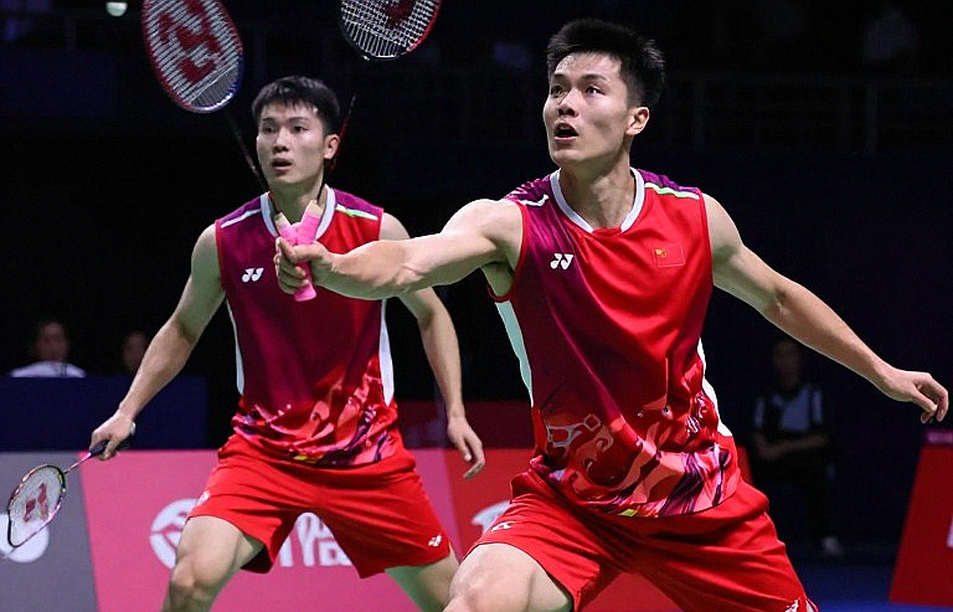
A three-game men's singles match at world level lasts on average 55 to 75 minutes. Over that time a player covers roughly 4.5 to 6 kilometres, depending on playing style and opponent. That distance is lower than a footballer's, but it is produced by an entirely different model: hundreds of short 2-to-5-metre bursts, each accompanied by a jump or a rotation, with almost no steady running to recover.
That is why the most important metric in badminton is not total distance but the number of explosive bursts per minute of play. In a top-level match, that figure often exceeds 20 per minute in the third game. A player with a good physical base but poor recovery between bursts collapses in the third game — not from exhaustion, but from failing to re-establish the central position after each shot.
For Nguyen Thuy Linh, a style built on defensive counter-attacking and extended rallies makes this metric even more important. She often concedes the initiative for the first two-thirds of a game to force opponents to create their own points, then accelerates late. That approach works against peers or lower-ranked opponents, but against the top ten it places the entire burden on something the eye cannot measure: psychological endurance in long rallies.
For Le Duc Phat the problem is inverted. He attacks, presses, and looks for the decisive smash relatively early in the rally. That style produces fast game wins, but it also produces two data consequences: more explosive bursts per minute, and a wider margin of error. An attacking player can win a game 21-15 with 12 winning smashes, then lose the next two because his smash conversion rate falls from 45 per cent to 28 per cent.
This is where match data is worth more than the scoreboard. If you look closely at the heat map of shuttle landing points, you will see where the match is actually decided — usually along the two side alleys, some 40 to 60 centimetres inside the line, and in the rear court, where a 10-centimetre difference in a deep push can turn defence into counter-attack.
At international events, Vietnamese players often lose not in the decisive rallies but in the third and fourth rallies of each sequence. Those rallies never appear in the point statistics. They only appear on video, in slow motion.
And this is the most valuable part: strong badminton nations do not invest in teaching strokes. They invest in measuring strokes and then correcting them. A training centre in East Asia can record an entire session with four cameras, reconstruct a 3D model of wrist movement, and compare it with that same player's model three months earlier. It does not require expensive technology. It requires someone with the time to sit and watch.
During a trip to cover an international event in Hanoi, I noticed a small detail. After each match, visiting players tended to sit down with their coaches, open a tablet, and review two or three specific rallies. Most Vietnamese players left the court immediately to catch the shuttle to their hotel. That difference, multiplied over several hundred matches a year, creates a gap that no fitness session can close.
Contrarian angle
The most common explanation for Vietnamese badminton's gap is physique and stamina. That explanation is convenient, and it is wrong at the most important point: it turns a systemic problem into a biological one, so that nothing needs to be done.
Among the world's leading players, average height is indeed greater. But if physique were the deciding variable, Japan — one of the strongest badminton nations, whose players are hardly dominant in height — could not exist. The deciding variable is not reach. It is the number of hours of high-quality competitive play a player accumulates before turning 22.
In Vietnam, an outstanding young player usually faces two options: stay home, win enough to become national champion but lack international opposition; or go abroad at their own expense, with one international tournament in Asia costing roughly 15 to 25 million dong for flights, hotel and entry fees, not counting a travelling coach. At ten tournaments a year, that figure is far beyond most families.
Nguyen Thuy Linh was not born under the spotlight. She was excavated from the dark — from small tournaments, from self-funded flights, from a chain of choices nobody guaranteed would lead anywhere.
Another blind spot is rarely mentioned: Vietnam's youth development system specialises quite early. Age groups from 13 to 15 are already classified by singles and doubles, and skills are drilled in a specialised direction. This produces fast results at youth level. But it also erodes movement diversity — something advanced badminton nations preserve by letting young players compete across multiple events until they are 17.
What to watch
Vietnamese badminton does not lack talent. It lacks a measurement mechanism and a dense enough competition calendar.
If over the next three years the number of Super 300-and-above international events Vietnamese players enter rises from one or two to six or seven a year, and if every match is recorded and systematically reviewed, that gap will begin to narrow. These are changes that do not require a huge budget. They require a decision-maker who understands that match data is a national asset, not merely something to write news about.
Before the score is written, the feet have already finished composing the symphony of movement. Our job is to learn to read that score.