
VAR Intervention Threshold in V.League: The Gap the Laws Do Not Fill
Minute 74. The referee touches his earpiece, nods once, and turns toward the...
Minute 74. The referee touches his earpiece, nods once, and turns toward the monitor set beside the touchline. The stands rise as one. The away players surround the second assistant, the man closest to the incident. On the big screen, the crowd sees a collision at the edge of the box, the ball changing direction, and a foot meeting an opponent's ankle.
The referee stops on the fourth frame. He watches it three times, at three different speeds. Then he shows a second yellow. The match tilts hard to one side, and fifteen minutes later the away team concedes.
Every argument in V.League 1 starts in that moment — in the interval before the card, when only one person on the pitch knows which threshold is being applied. The core problem with VAR in Vietnam is that the intervention threshold has never been written down as a measurable standard.
I make a habit of rewatching these clips, pausing on the exact frame the referee paused on, to answer something no law text contains: why does one referee believe the offence is clear enough, while another, in another match, believes it is not?
VAR arrived late in V.League, and it arrived unevenly
VAR entered V.League 1 from the 2026 season, after years of delay caused by infrastructure costs and a shortage of operators. By the 2026-24 season, the league could deploy it in most matches, though not all. That unevenness created a problem of its own: the same incident, in a round with VAR and a round without it, produces two different outcomes.
Football does not have VAR; it has blind spots waiting to be exposed. But in a league with limited resources, the gap between matches with and without the technology becomes a genuine tactical variable. A team that knows VAR is active adjusts how it defends inside its own box; a team that knows it is absent exploits collisions it would otherwise avoid.
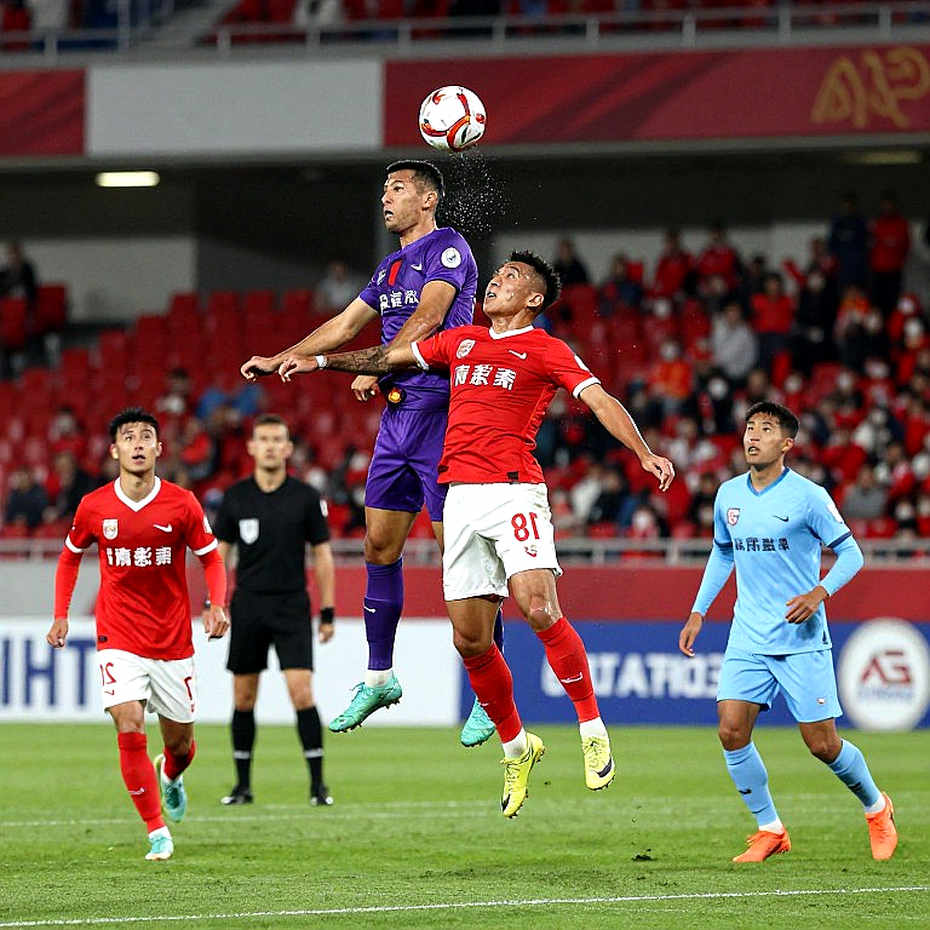
The legal basis for VAR is the IFAB Video Assistant Referee Protocol, written into the Laws of the Game in 2026. The protocol limits VAR to four categories: goal or no goal, penalty or no penalty, direct red card, and mistaken identity. Within those categories, the threshold is a clear and obvious error, or a serious missed incident.
IFAB does not define clear and obvious with any quantitative measure. There is no number of metres, no number of frames, no time threshold. It is a qualitative standard, designed to hand judgement back to people — and for that very reason, it depends on how those people are trained.
Three levels of an intervention
Under the IFAB protocol, an incident is not handled as a single review. It passes through three levels. Level one is a check — the VAR operator reviews while play continues. Level two is a review — the referee is asked to the monitor. Level three is an overturn — the original decision is changed.
These levels carry different meanings. A check leaves no trace in the record. A review leaves a trace but does not change the outcome. Only level three genuinely changes a match's fate.
When fans say VAR ignored an incident, they are usually describing level one — a check that led to no action. But without a public log, they cannot know whether the incident was checked at all. That opacity feeds the worst hypothesis.
The threshold: a qualitative standard inside a quantitative system
When a Vietnamese referee walks to the monitor, he is not looking for right or wrong. He is looking for a degree of wrong large enough to justify overturning the on-field decision. The process has an internal logic few outsiders grasp: the on-field decision is presumed correct unless it is shown to be clearly wrong.
That structure is designed to protect the referee's authority. It also produces an inverse effect: when VAR intervenes, responsibility does not vanish, it simply moves from the on-field referee to the VAR operator. VAR does not fix mistakes; it changes who carries the blame.
Based on my experience tracking matches across several seasons, the concern is not the number of wrong decisions but the drift between rounds. The same type of collision can be a penalty in round five and nothing in round fifteen. Fans see the inconsistency and call it competence. The deeper issue is calibration: with no published threshold, each VAR team calibrates against its own experience.
A qualitative standard is stable only when those applying it share a common reference point. In Europe's top leagues, that reference is built through hundreds of hours of joint analysis, post-round review sessions, and an independent panel that publishes contentious decisions. In V.League, the review mechanism exists, but most of it happens behind closed doors.
Hand and ball: the hardest threshold
Among the four categories, handball generates the most argument, because the handball law has changed repeatedly in recent years. Current criteria revolve around the arm's position relative to the body, the ball's direction of travel, and the reaction distance.
No frame answers whether that arm was natural. It is a judgement about movement, not about geometry. In a league with few shared analysis hours, this judgement drifts the most.
I have logged many handball incidents in V.League and found a pattern: penalty decisions cluster around situations where the ball travels a short distance and the arm sits high. Yet similar incidents go unpunished. The difference lies in whether that day's VAR team felt confident enough to overturn the call, not in the geometry of the arm.
Semi-automated offside and the infrastructure limit
Offside carries the most quantitative parameters: the player's position, the moment the ball leaves the passer's foot, and which body parts may score. Semi-automated offside technology is designed to resolve those three parameters precisely, using sensors and multiple cameras.
That technology demands infrastructure most V.League grounds do not have. In Vietnam, offside is still determined by eye and a manually drawn line. The error here is small physically but large in outcome: a few centimetres can be a goal.
This asymmetry raises a fairness problem between matches. If some matches use more accurate technology than others, the final table is built on different measurement foundations.
Match rhythm and the price of dead time
One rarely discussed aspect is VAR's effect on match rhythm. Each review runs from one to three minutes, and that time is added to stoppage. But the emotional rhythm of the match is not added back.
A team with momentum often loses it after a long review. A team under pressure gains time to reorganise. This is a tactical variable no coach controls, yet every coach must account for it.
I once stayed behind after a match to measure total VAR dead time against actual stoppage time. The gap was small, but the distribution was heavily skewed: most dead time fell in the second half, exactly when matches are tightest.
Who is allowed to trigger the process?
In a match with VAR, the operations room holds the VAR, the assistant VAR, and technicians. Only one person has the authority to propose an intervention. What I always ask myself when rewatching footage is: who is permitted to trigger the process, and on what basis?
Fans often assume VAR checks every incident automatically. In practice, VAR actively checks only the four categories above, and intervention happens only when the operator judges there is a clear error. That leaves a gap between incidents examined and incidents acted upon. That gap is where every argument is born.
The referee is the only person on the pitch not permitted to be led by emotion. So is the VAR operator, and they work in a room with no crowd, no roar, only monitors. That isolation can be an advantage, removing the pressure of the stands, but it can also be a disadvantage, removing the felt rhythm of the match.
Referee training: the personnel bottleneck
A VAR system needs two kinds of people: referees able to operate the technology, and technicians able to reconstruct incidents. Vietnam has a group of FIFA-recognised referees, but far fewer qualified to operate VAR. This is a structural problem before it is a training problem: a referee who wants to work VAR needs match experience, and that experience only comes from appointments.
When personnel are thin, VAR teams rotate rarely. Rare rotation means few collisions with different calibration methods, and few chances to discover that one's own threshold has drifted. It is a closed loop: too few people leads to too little diversity of judgement, and too little diversity leads to an unstable threshold.
This cannot be solved by buying more equipment. It needs a long-term training pathway, in which young referees enter VAR operations early and are assessed against the same criteria. Without that pathway, every season repeats the same argument under a different name.
VFF, VPF and the question of publication rights
In Vietnam, league operations fall to the Vietnam Professional Football Joint Stock Company, while referees sit within the Vietnam Football Federation system. Two bodies, two processes, one shared product. That boundary raises a question about publication rights: who has the authority to explain a contentious decision, and within what timeframe?
In leagues that publish VAR logs, the answer exists before the question is asked. In leagues that do not, the answer usually appears only when pressure is high enough. The difference lies in institutional design, not in capability.
When players learn to play with VAR
VAR changes player behaviour in ways nobody predicted. Knowing that every collision in the box may be reviewed, some players begin seeking contact rather than avoiding it. It is a rational response to a system that rewards going down.
In V.League, this phenomenon appeared later than in European leagues, but it is arriving. Referees must distinguish a genuine collision from a manufactured one, and that is a judgement about intent — precisely the kind of judgement data cannot supply.
This creates a paradox: the more technology, the greater the need for human judgement, not less. VAR does not replace the referee; it places the referee in a harder position, where every decision can be dissected at frame speed.
AFC slots and the brand value of refereeing quality
At continental level, Vietnam's slots in the AFC Champions League Elite and AFC Champions League Two depend on club results and league organisation standards. Refereeing is part of that standard. A league with a stable VAR system faces an easier path through AFC assessments, from stadium licensing to match operations.
Put another way, the VAR threshold reaches beyond domestic fairness. It is part of the capability file Vietnam presents to the continent. When a Vietnamese club walks onto an AFC pitch, it carries the refereeing system that produced it.
The player export pipeline and pressure to professionalise
While V.League struggles with the VAR threshold, the flow of Vietnamese players abroad grows thicker. Doan Van Hau joined SC Heerenveen on loan in 2026 and became the first Vietnamese player to appear in the Eredivisie. Nguyen Quang Hai signed with Pau FC in Ligue 2 in 2026. Nguyen Cong Phuong wore the shirts of Mito HollyHock in the J.League and Incheon United in the K League. These moves reach beyond personal stories; they place V.League on a comparative scale.
When a player grows used to every collision being reviewed at frame speed, he returns to the national team with a different expectation of consistency. That expectation spreads to teammates, to coaches, and finally to fans. It is healthy pressure, but it only helps if the domestic system can meet it.
Conversely, when the intervention threshold drifts, players learn a dangerous lesson: outcomes depend on who sits in the VAR room, not on their own behaviour. That is the kind of lesson that corrodes a competitive culture at the root.
The counter-intuitive angle: emotion and law
Most arguments in the stands centre on whether the referee was right or wrong. That question, reasonable as emotion, misplaces the focus. A referee can decide wrongly within a correct process, and conversely can decide correctly thanks to a loose one.
Viewers see the incident, referees see the moment, and I see the whole process. This difference explains why two people watching the same clip reach opposite conclusions while both are honest. One is reacting to an outcome; the other is following a chain of verification steps.
Fan emotion is not worthless. Emotion is data about expectation. When thousands of people see an incident as wrong, it signals that the league's published threshold has drifted from the shared one. The problem is that this signal is rarely converted into structured dialogue, and instead becomes personal accusation.
Personal accusation is the easiest way to end an argument, and the least useful. It turns a system failure into a person's failure, and therefore guarantees the system failure will recur.
What a mistake can teach
I once mispronounced a player's name three times in a major match, and the lesson I drew was not to be more careful but to understand better the mechanism I was operating. The same logic applies to referees: a mistake has value only if it leads to a change in process.
Every foul is a question about intent; data only gives us the answer about consequence. In football we never read intent — we read movement, speed, contact angle and ball direction. VAR gives us more data, but not more truth about intent.
So any effort to turn VAR into an automatic judging machine runs against the nature of the game. VAR is a tool to reduce error, not to remove judgement. Anyone promising otherwise is promising something that does not exist.
Takeaway
The sensible path for V.League is to publish a calibration threshold, release a VAR intervention log after every round, and tie referee training budgets to the AFC licensing roadmap. None of that costs much, but it turns arguments from emotion into verifiable data.
The laws never stand outside the match; they are the second match running in parallel. And in that second match, V.League is still in the first half."